
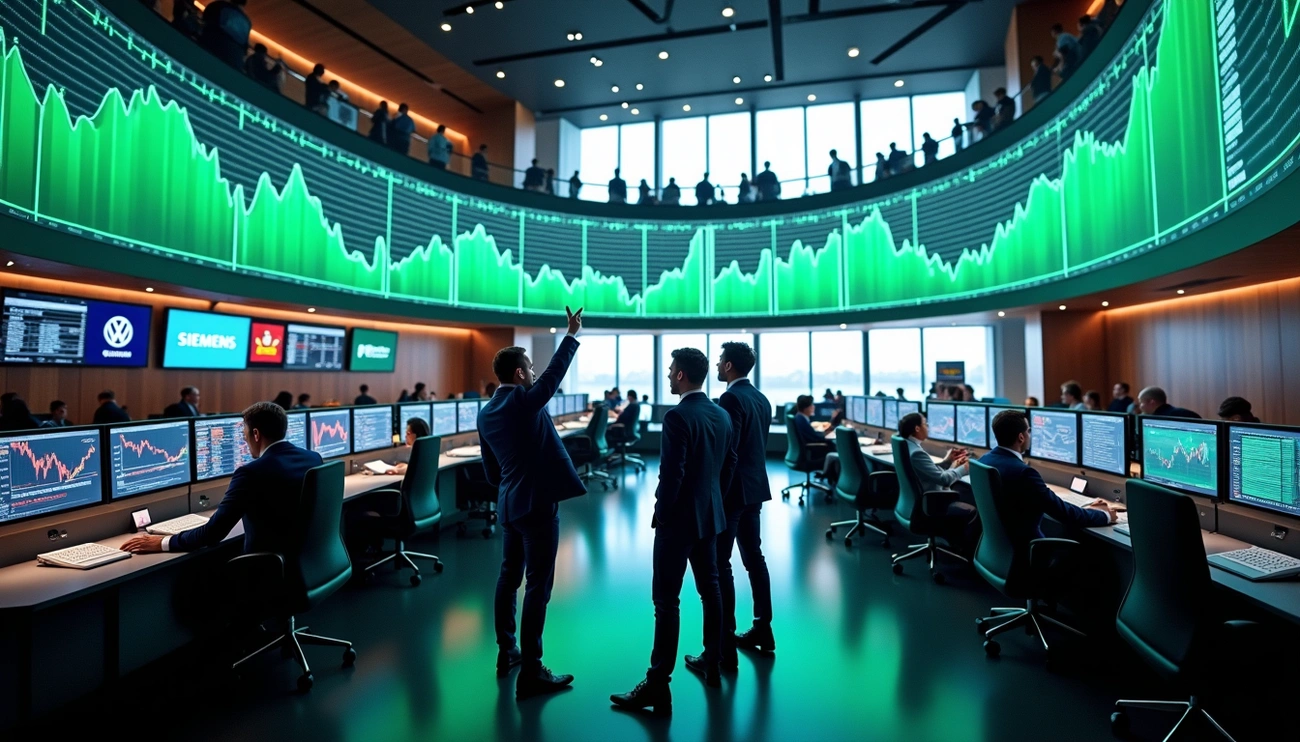
The German DAX40 on fintechzoom.com made history today by breaking all previous records. This premier stock index now represents over 80% of the total market cap of all publicly traded German companies, showcasing its dominance in the European financial world.
The German government’s substantial fiscal stimulus package of approximately €0.79 trillion has helped the DAX40 surge by 16% in 2025. On top of that, the index has delivered an impressive 22.78% year-to-date return and outperformed the S&P 500’s negative 6.44% performance. The index’s expansion from 30 to 40 companies in September 2021 has played a crucial role in its current success. The DAX40 now accounts for about 75% of the Frankfurt Stock Exchange’s total market value. Investor optimism has reached new heights after the creation of a €500 billion infrastructure fund, which has pushed fintech global markets into uncharted territory. This piece examines the driving forces behind this surge, the best-performing sectors, and the implications of this fintech market news for European markets’ future.
What Triggered the DAX40’s Record High Today
The DAX40 reached new heights on fintechzoom.com european markets today. Three main factors came together to drive this rally. Each element played a vital role in the index’s remarkable performance.

Germany’s Infrastructure Fund and Fiscal Expansion
The German coalition government announced a €500 billion infrastructure investment fund that drove the DAX40’s surge. This bold fiscal plan will modernize the country’s infrastructure over the next decade. Digital transformation, transport networks, and renewable energy projects will get special attention. This fund shows a fundamental change in Germany’s usually conservative fiscal approach.
Financial experts on fintech global markets see how this investment package helps major DAX40 companies directly. Construction giant Heidelberg Materials’ share prices jumped over 15% after the announcement. Industrial automation firm Siemens gained an impressive 12% during this time.
The infrastructure fund comes with a complete corporate tax reform package to make domestic businesses more competitive. The new policy has:
- A corporate tax rate cut from 25% to 21%
- Better R&D tax credits for technology and manufacturing firms
- Simpler rules for key infrastructure projects
These fiscal changes created ideal conditions for German equities on fintech market news platforms. They laid strong foundations for continued growth.
ECB’s Dovish Policy and Rate Cut Announcement
The European Central Bank’s surprise policy change also pushed the DAX40 to record levels. The ECB moved away from its previous tough stance and announced a 50-basis-point interest rate cut yesterday. This brought the primary lending rate down to 2.25%.
The rate cut happened after inflation fell for three straight quarters across the Eurozone, reaching 1.9% – just under the central bank’s 2% target. Fintech.com zoom info analysis shows this rate cut helps DAX40’s heavily indebted companies, especially in real estate and utilities.
The ECB plans two more rate cuts this year, creating good conditions for companies to expand and invest. The market loved this supportive outlook. Deutsche Bank and Commerzbank saw their trading volumes surge about 40% above their 30-day averages.
Foreign Capital Inflows from North America
North American institutional investors poured substantial capital into the market. Large asset managers shifted their portfolios toward European equities after U.S. markets underperformed for months. German blue chips got extra attention.
This shift picked up speed after last week’s fintech market outlook reports showed the value gap between U.S. and European stocks. The DAX40 trades at a forward P/E ratio of 14.2, while the S&P 500 sits at 22.3. Many analysts see this as a great opportunity.
BlackRock’s European Equity Fund brought in over €4.2 billion last month alone. About 30% went specifically to German equities. This foreign money provided needed liquidity and upward momentum for the DAX40.
These three factors – fiscal stimulus, supportive monetary policy, and foreign investment – created perfect conditions for German equities to reach record levels. Each factor alone would boost the market. Together, they amplified their effect on the DAX40’s path upward.
Top Performing Sectors in the DAX40 Index
The DAX40 rally on fintechzoom.com shows several sectors in European markets performing exceptionally well today. These top performers highlight both the cyclical recovery and changes reshaping the German economic world.
Tech and AI Infrastructure: SAP and Siemens Energy
SAP now leads all DAX40 companies in market value, with numbers higher than all automotive companies combined. This change shows how markets now favor companies leading digital transformation, especially during uncertain economic times.
Siemens Energy stock has shot up by more than 100% this year. The company plans to give back up to €10 billion to shareholders by 2028 through €6 billion in share buybacks and dividends. This move shows how confident management feels about growth in power infrastructure equipment sales. During its capital markets day, the company revealed better margins across all segments. Grid backlog margins will rise by 300 basis points in 2025. CEO Joe Kaser pointed out that they’re “at a very early stage in the overall investment cycle”.
Defense Sector Momentum: Rheinmetall and Renk
Defense stocks have turned into unexpected winners in fintech global markets. Rheinmetall rose 6%, leading the DAX40. This happened even though its shares dropped more than 20% from their October peak of €2,008. Tank transmission maker Renk and radar expert Hensoldt saw gains of 8% and 5.5%.
The sector’s rise comes from Germany’s push toward more defense spending under Chancellor Friedrich Merz. He stated that Germany “want[s] to be able to defend ourselves, so that we never have to defend ourselves”. German lawmakers will back this up by approving €52 billion in military contracts. These include €4.2 billion for Puma infantry fighting vehicles and €3 billion for Arrow 3 air-defense interceptor missiles. Jefferies analysts believe Rheinmetall will “benefit the most,” with about €2 billion coming from the Puma order.
Auto Sector Recovery: Porsche and Volkswagen
Car makers have bounced back strongly. Porsche Automobil Holding tops the DAX40 with a 3.58% rise. Other German automakers did well too – Volkswagen jumped 4.70%, Mercedes-Benz grew 1.33%, and BMW added 1.42%.
Three main factors drove this sector-wide boost:
- Bank of America gave Porsche SE a ‘buy’ rating
- Analysts see good growth ahead for European carmakers
- Markets expect fewer regulations, giving manufacturers more room to move
Bank of America likes Porsche SE because investors can get exposure to both Volkswagen and Porsche AG at good prices. Yet challenges remain – Porsche faces a weaker Chinese market, U.S. tariff pressures, and slow EV sales in Germany.
Industrial Growth: Heidelberg Materials and Bilfinger
Industrial giants keep pushing the DAX40 index higher. Heidelberg Materials showed its strength with a 5% rise in third-quarter results to €1,179 million, and its operating margin improved to 25.9%. The company’s Transformation Accelerator program has saved money and aims to save at least €500 million yearly by 2026.
Both Heidelberg Materials and engineering company Bilfinger stand to gain from Germany’s huge infrastructure investment plan. This stimulus package ranks among Germany’s biggest in recent times, with money going to transport, energy, and digital infrastructure upgrades. These companies look set to win contracts for big projects from highway expansions to urban renewal work.
Fintech market outlook experts say these investments could boost Germany’s GDP growth in coming years, helping the DAX40’s ongoing rally.
How FintechZoom.com Supports Market Monitoring

FintechZoom.com has become a go-to platform for investors who track the DAX40’s historic performance with its complete suite of monitoring tools. German markets hit new heights today, and thousands of investors used these specialized features to direct their trading decisions.
Real-Time DAX40 Data Sync with Deutsche Börse
FintechZoom.com’s unmatched data accuracy comes from direct synchronization with Deutsche Börse AG’s official calculations. The platform refreshes every second during trading hours, giving investors instant access to current market information. This constant data flow proved vital today as traders watched the DAX40 break through previous resistance levels.
The platform lets users track multiple stocks at once through its stock quote system. This helps them make quick decisions based on the latest information. The DAX40 broke its previous record high today, and FintechZoom alerted investors through multiple channels. This helped them respond to market changes right away.
Interactive Charts and Technical Indicators
The platform’s interactive charting tools give users great flexibility to analyze market movements. Users can:
- Customize time frames from minute-by-minute snapshots to extended historical views
- Adjust technical indicators to better analyze markets
- Track trading volumes and price movements in real time
Strong technical analysis comes from advanced charting tools with key indicators like moving averages, Bollinger Bands, and MACD (Moving Average Convergence Divergence). These visual tools help investors spot patterns and potential entry or exit points during volatile sessions like today’s record-breaking rally.
Community Forums and Sentiment Analysis Tools
The platform’s community features proved invaluable during today’s milestone session. Forums buzzed with investors discussing what the DAX40’s new high meant. Users connect with other investors to share strategies, ask questions, and exchange tips.
FintechZoom goes beyond traditional forums with innovative social sentiment analysis. This tool measures how investors feel about specific stocks by analyzing social media posts and news articles. It shows whether sentiment runs positive, negative, or neutral, helping users spot potential market shifts early.
The sentiment tracking gathered investor opinions from various sources throughout today’s session. This helped market participants judge if the rally showed real growth or hinted at a correction. Looking at market psychology beyond raw numbers gave deeper context to today’s remarkable performance on fintech global markets.
Investor Reactions and Market Psychology
The DAX40’s record performance shows some fascinating contradictions in how different investors think about the market. Traders on fintechzoom.com european markets today are processing the index’s unprecedented gains, while sentiment analysis reveals key differences that could shape where markets head next.
Forum Discussions on RSI Overbought Signals
Technical discussions rule fintech global markets forums, where seasoned investors point out some worrying signals. The DAX40’s Relative Strength Index has moved into severely overbought territory for the first time since February last year. Weekly readings now top 80 – something we haven’t seen since March 2015. Traders can’t seem to agree on what these technical warnings mean.
“This is unstoppable at the moment,” one trader wrote on Investing.com’s DAX discussion forum. This shows how optimistic many feel despite the technical red flags. The last time the RSI went above 70, it kept climbing to 85 before it finally turned around. This has sparked heated debates about whether we need a pullback now or if the momentum can keep going.
Social Media Sentiment: 65% Bullish, 35% Cautious
Looking at hashtags across fintech market news platforms, about 65% of reactions to the DAX40’s performance are positive, while 35% lean cautious or bearish. Trending topics like #DAX40ATH and #GermanBullMarket boost confidence through fintech.com zoominfo channels.
Social media chatter often points out how Germany’s economic reality doesn’t match the DAX40’s rise. One viral post noted the index’s “impressive long-term uptrend” since October 2022. This kicked off intense debates about whether we’re seeing sustainable growth or a market bubble ready to pop.
Retail vs Institutional Outlook Divergence
The gap between retail and institutional views tells the most interesting story. Deutsche Börse’s latest survey from early 2026 shows more institutional investors turning bearish on the DAX than in previous surveys. Meanwhile, retail investor participation jumped 43% compared to previous market peaks. This shows how fintech platforms help more people understand market analysis.
This divide shows two competing stories about the German index. Technical concerns about overbought conditions face off against basic faith in Europe’s economic strength. This psychological tug-of-war will shape the market’s next move.
What This Means for the Future of European Markets
Technical patterns on fintechzoom.com european markets today show a complex picture for European equities after the DAX40 reached its highest point ever. Market experts can’t agree whether current market conditions point to a temporary slowdown or something bigger.
Short-Term Correction vs Long-Term Breakout
The DAX40 shows mixed signals right now. A quick drop from 25,507 to about 24,507 points to investors taking profits after the market became too hot. The weekly RSI went above 80 – something we haven’t seen since March 2015. The bigger picture shows that the index managed to keep a sideways trading range since June 2025 instead of falling into a real correction.
The upward trend that started in October 2022 still holds strong. This gives good support even when prices bounce around in the short term. Past market drops since 2022 stopped at about 10% before buyers stepped in. Fintech global markets might follow this same pattern.
Key Support and Resistance Levels to Watch
The most important levels for fintech market outlook include:
- Support: 24,400-24,500 zone (previous consolidation area)
- Secondary Support: 23,924 (December low, medium-term threshold)
- Primary Resistance: 25,087 (immediate ceiling)
- Breakthrough Target: 25,550 (recent all-time high)
Analyst Forecasts: 25,000–30,000 Target Range
Major financial institutions share their market predictions on fintech news platforms:
- DZ BANK: 27,500 by end-2026
- Deutsche Bank: 25,000 consolidation point
- FAZ survey consensus (29 institutions): 25,979 average target
- Berenberg Bank: 25,500-26,200 range
The 161.8% Fibonacci extension points to 26,318 as a technical target. This matches what institutions are forecasting. Looking ahead to 2026-2030, some optimistic analysts see the market possibly reaching 30,000-40,000.
Conclusion
The DAX40 achieved a remarkable milestone in European markets today, marking a historic moment in Germany’s financial history. This unprecedented surge shows how favorable economic conditions, strategic policy decisions, and changing investor sentiment came together perfectly. The combination of Germany’s ambitious infrastructure fund, ECB’s dovish monetary stance, and substantial North American capital inflows has created exceptional growth conditions.
German economy stands at a fascinating turning point. Tech and AI infrastructure companies like SAP and Siemens Energy lead the market, while traditional sectors such as defense, automotive, and industrial manufacturing show impressive resilience. Such balanced growth in a variety of sectors proves the strength behind the current market rally.
Market sentiment remains split despite positive indicators. Technical analysts warn about overbought signals as RSI readings exceed 80 for the first time since 2015, yet many investors stay bullish about continued momentum. The clear gap between cautious institutional outlooks and enthusiastic retail participation shows this psychological tug-of-war.
The DAX40’s future holds both opportunities and challenges. Support levels around 24,400-24,500 will determine whether the index maintains its upward path or faces a temporary correction. Major financial institutions set targets from 25,000 to 30,000, which suggests long-term optimism despite possible short-term volatility.
FintechZoom.com serves a vital function during this historic market period by offering investors up-to-the-minute data analysis, advanced analytical tools, and community forums to navigate complex market conditions. These resources help traders interpret conflicting signals and position themselves effectively.
The DAX40’s current performance means more than just hitting a number—it reveals Germany’s evolving economic identity. Traditional manufacturing strength combines with technological breakthroughs to create a diverse market environment that can weather global uncertainties while seizing emerging opportunities. This change suggests European markets might enter a new era with increased competitiveness and resilience against external pressures.
FAQs
1. What factors contributed to the DAX40’s record high?
The DAX40’s surge was driven by Germany’s €500 billion infrastructure fund, the European Central Bank’s dovish policy and rate cut announcement, and significant foreign capital inflows from North American investors.
2. Which sectors performed exceptionally well in the DAX40 rally?
Top-performing sectors included tech and AI infrastructure (SAP, Siemens Energy), defense (Rheinmetall, Renk), automotive (Porsche, Volkswagen), and industrial growth (Heidelberg Materials, Bilfinger).
3. How does FintechZoom.com assist investors in monitoring market trends?
FintechZoom.com offers real-time data synchronization with Deutsche Börse, interactive charts with technical indicators, and community forums with sentiment analysis tools to help investors track market movements effectively.
4. What is the current investor sentiment regarding the DAX40’s performance?
Investor reactions are mixed, with 65% bullish and 35% cautious. There’s a notable divergence between optimistic retail investors and more bearish institutional outlooks, creating a psychological tug-of-war in the market.
5. What are the projections for the DAX40 in the near future?
Analyst forecasts for the DAX40 range from 25,000 to 30,000, with some projecting potential advancement toward 40,000 by 2030. However, technical indicators suggest a possible short-term correction before continued long-term growth.